

Why Aerate Your Lawn?
WHY AERATE YOUR LAWN?
You want your lawn to stay as green and beautiful as possible, which is why you take the time to water and fertilize. But, you might notice that, after time, you’re not seeing the desired results. It could be that your soil has compacted, keeping water and nutrients from penetrating into your grass’ root systems. Aerating your lawn can help open the soil back up, letting those nutrients get to where they need to be to allow your grass to flourish.
WHAT IS AERATION? COMPACTION AND THATCH
Compaction happens when your soil becomes firmly pressed together. It generally happens in higher traffic areas, like sports fields, playgrounds, and other recreational areas. Lawns that have new construction built on them will usually wind up with some to a lot of soil compaction.
Compaction can also occur when your soil composition includes a high amount of clay. For lawn in areas like Niagara, this will be pretty common.
DIAGNOSING THE PROBLEM
The problem with soil compaction is that it doesn’t allow water, oxygen, or nutrients to easily reach grass roots. Dense soil also constricts root movement and growth. If your roots can’t reach the things they need, your grass will suffer.
Similarly, an overabundance of thatch can choke out your grass as well. Thatch is an accumulation of dead grass clippings, shoots, and stems that form along the top layer of your lawn. It forms a barrier between your grass blades and the soil.
A little bit of this is actually good for your lawn as its decomposition delivers nutrients back to the soil. However, it can become a problem if it becomes too thick. Too much thatch blocks air and water from reaching the soil.
DO YOU HAVE A PROBLEM THAT REQUIRES AERATING YOUR LAWN?
Thankfully, it’s pretty easy to tell if aerating your lawn would help and if you have compacted soil. Patchy, unhealthy looking grass with bare spots indicates that water and oxygen aren’t reaching your roots. If your plants don’t seem to grow, or your trees have shallow root systems, you have a clear sign that the soil is constricting root movement. Excessive puddling and water running down from higher areas in your lawn also indicate that your soil isn’t absorbing the water.
You can tell if you have an overabundance of thatch fairly simply as well. Walk on it with bare feet; healthy lawns feel soft but firm, while thatchy lawns feel spongy and springy.
You can also feel your lawn using your fingers. Too much thatch is anything more than a half-inch layer, so if you can insert your finger past your first knuckle, you know that your thatch layer is working against you.
Thankfully, aerating your lawn can help with both these issues.
BREATHE…LET THE HEALING BEGIN
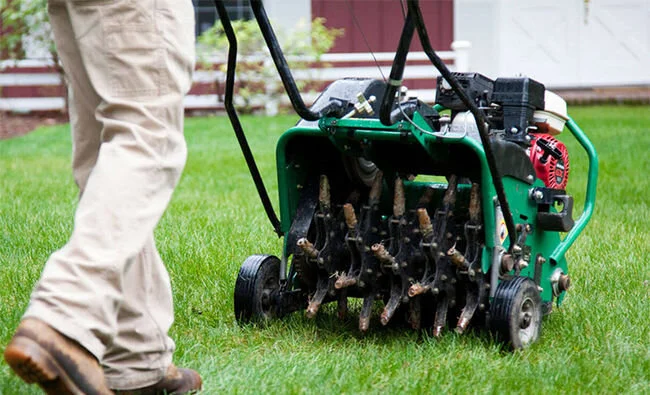
Basically, aerating your lawn involves punching holes into the soil to break up that compaction and thatch. This allows oxygen and water to absorb back into the soil, as well as giving fertilizer a fighting chance at getting down into the root system. Effective aeration loosens soil enough to let roots and earthworms move more freely. It also lets new grass seeds germinate.
AERATING YOUR LAWN: WHEN AND HOW
The common wisdom surrounding when you should go about aerating your lawn looks pretty simple. Aerate your cool season grasses in the Fall and your warm season grasses in the late Spring.
For those of you who have healthy lawns, most Pros recommend aerating once a year. Lawns that struggle with compacted soil and thatch issues can benefit from aeration at least twice a year.
For lawns that don’t necessarily have compaction problems but could stand a good dethatching, we can help there too!
REACH OUT TO OUTDOOR ELEMENTS TODAY FOR YOUR FREE LAWN AERATION QUOTE TODAY!
credit https://opereviews.com/aerating-your-lawn/ by Chris Boll